
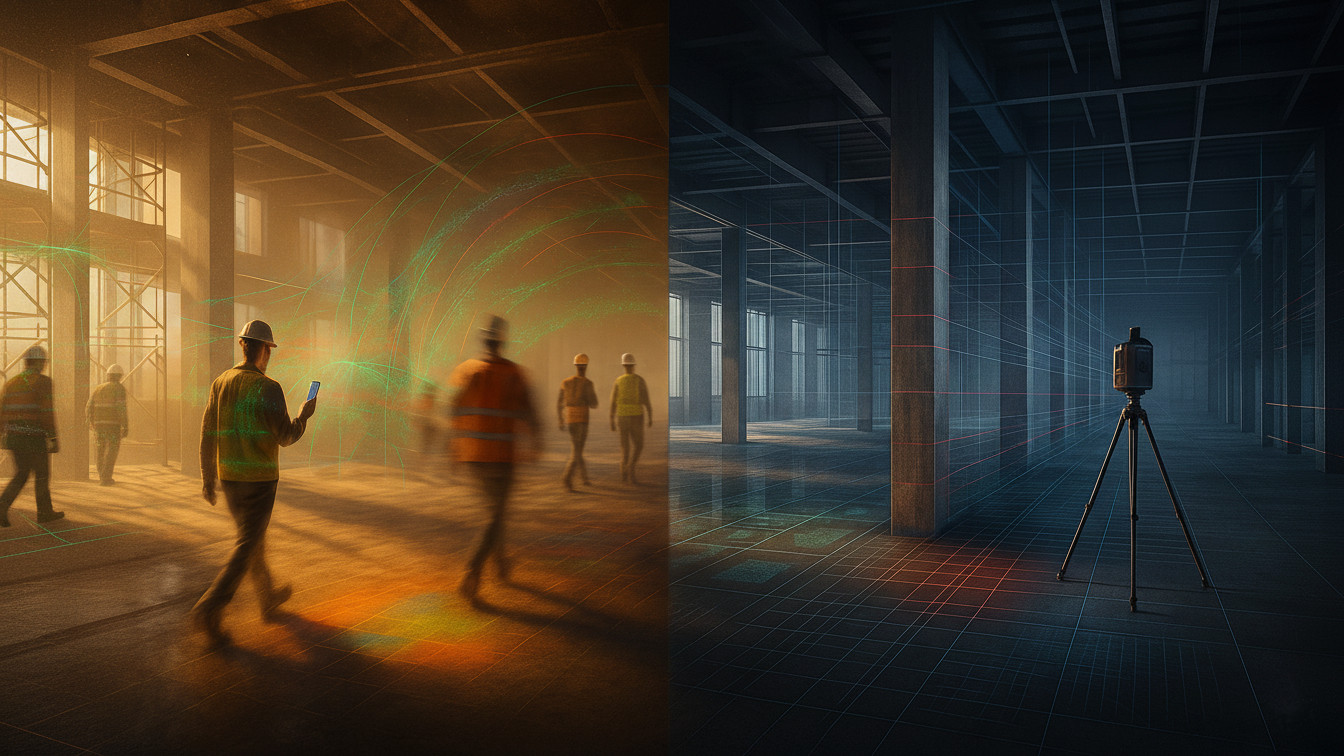
Capture Fast, Verify Exact

Most construction teams need two things that rarely coexist: daily visibility and numbers you can stake a payment on. Phone-based monocular SLAM gives you cheap, frequent walkthroughs; terrestrial laser scanning (TLS) and mobile LiDAR SLAM deliver geometry you can trust against tolerances. The pragmatic answer isn’t either/or — it’s cadence. Use monocular runs for context and momentum, sweep with mobile SLAM weekly to catch room-scale issues, and bring in TLS at milestones or whenever millimeters decide cost. Keep the whole pipeline honest with LOA v3.1 tags so “accurate” means something, and lean on ASTM E3125 when you need to verify instruments for acceptance. Expect visual methods to stumble in blank, shiny, or dynamic scenes; plan loop-closure-friendly routes and anchor scale to the model. In tight corridors or busy zones, modest custom anchoring or dynamic-point filtering can calm drift without overhauling your stack. Bottom line: monitor often, escalate on risk, and leave a clean audit trail from capture to BIM.

Common Questions

Q: When should I choose TLS over mobile SLAM or monocular SLAM? A: Use TLS when millimeters decide cost or safety — fit-up, acceptance checks, tight MEP clearances. It’s slower, but it’s the reference you sign against.

Q: How do I keep phone-based monocular SLAM from drifting? A: Plan loop-closure-friendly routes (revisit landmarks), add simple anchors tied to BIM/control, avoid long, repetitive corridors without features, and limit fast, jerky motion.

Q: What cadence actually works on a busy interior build? A: Daily phone walkthroughs for visibility, weekly mobile SLAM sweeps for room-scale issues, and TLS at milestones — or immediately when a tolerance risk appears.

Q: How do standards fit into day-to-day workflows? A: Tag outputs with LOA v3.1 so accuracy expectations are explicit, and rely on ASTM E3125-style performance documentation when scans inform acceptance or payment.

Q: Mobile SLAM says “centimeter-class” accuracy — what does that mean in practice? A: Expect several centimeters global accuracy in typical interiors, with more noise than TLS. Validate against control, and spot-check with TLS where deviations are costly.

Q: Where do monocular SLAM and mobile SLAM usually fail? A: Blank or shiny surfaces, poor lighting, moving crews, and long repetitive corridors reduce feature repeatability, weaken loop closure, and raise drift or noise.

Q: Are there cases where a custom approach is worth it? A: Yes — narrow corridors with heavy foot traffic or high-throughput capture. Lightweight anchoring and dynamic-point filtering can stabilize results; otherwise stick to off-the-shelf pipelines.
Contact Elf.3D to explore how custom mesh processing algorithms might address your unique challenges. We approach every conversation with curiosity about your specific needs rather than generic solutions.

*Interested in discussing your mesh processing challenges? We'd be happy to explore possibilities together.*

Fast vs. Exact: Choosing Monocular SLAM or Laser Scanners for Site Progress

Construction teams wrestle with two incompatible goals: see progress often and trust measurements absolutely. Phone-based monocular SLAM makes daily walkthroughs cheap and fast; tripod terrestrial laser scanning (TLS) and mobile LiDAR SLAM produce geometry you can check against tolerances. A pragmatic path is hybrid: use lightweight capture for routine visibility, escalate to survey-grade scans when decisions hinge on millimeters, and make expectations explicit with shared accuracy language. The USIBD Level of Accuracy (LOA) Specification v3.1 provides that language; ASTM E3125 describes how to verify instrument performance when it matters.

What the standards actually do

LOA v3.1 (2025) clarifies how to communicate accuracy in deliverables and adds guidance on expressing tolerances via standard deviation, making conversations about “±10 mm” less ambiguous in BIM/VDC scopes. In practice, it enables teams to choose tools by tolerance rather than habit.

When acceptance or payment depends on numbers, ASTM E3125-17 offers test methods for point-to-point distance errors in medium-range 3D imaging systems. You can use its procedures (or vendor reports based on them) to qualify a scanner/workflow for a specific band of tolerances before relying on it for sign-off.

How monocular SLAM behaves on site

On modern phones, “world tracking” fuses camera frames with the IMU — visual-inertial odometry (VIO) — to estimate motion and build a map in real time. It thrives on texture, light, and moderate motion; performance degrades with large blank areas, glare, or many moving workers. Loop closure reins in long-path drift by recognizing previously visited places and optimizing the pose-graph — critical in repetitive corridors common to commercial interiors.

Depth on phones helps with occlusion and coarse geometry. Google’s ARCore Raw Depth exposes per-frame depth that is more geometrically accurate than the fully smoothed Depth API, at the cost of missing pixels — useful nuance for QA overlays, but it doesn’t guarantee metric scale without anchors or external references.

TLS vs. mobile LiDAR SLAM: what recent studies say

Static TLS still leads for local fidelity. A 2025 comparative indoor study found the Leica RTC360 achieving ~1.2 mm absolute accuracy, while new-generation SLAM systems (e.g., Hovermap ST-X, FARO Orbis) approached TLS noise levels (~2.1–2.2 mm after smoothing) yet continued to trail TLS in absolute accuracy and stability. Another 2025 comparison reported SLAM errors rising into the centimeter to decimeter range in challenging conditions, reinforcing TLS as the reference when millimeters matter.

A simple tolerance-to-modality map

Tolerance band LOA cue Suggested modality Notes
≤ ±5 mm High (fit-up/acceptance) TLS (tripod) Authoritative geometry; plan setups & registration; verify per E3125 when required.
±10–20 mm Medium (partitions/services) Mobile LiDAR SLAM Fast coverage; validate against control, spot-check with TLS on risks.
≥ ±30 mm / presence Low (progress/context) Monocular SLAM Highest frequency; anchor scale; favor loop-closure-friendly routes.

Decision axes & typical failure modes

  • Accuracy vs. drift. If a decision is truly millimetric (e.g., MEP fit-up), use TLS. For room-scale routing and progress checks, modern SLAM often suffices; for simple presence/absence, monocular SLAM is fine — anchored.
  • Environment & scene dynamics. Visual methods need texture and stable scenes. Blank drywall, reflective finishes, dust, and moving crews reduce feature repeatability and complicate loop closure, increasing drift. Plan capture paths that maximize loop opportunities.
  • Coverage vs. occlusion. Mobile SLAM sweeps quickly and sees around obstacles; TLS resolves small deviations once staged correctly. Pick the failure you can tolerate: missing small deviations (favor TLS) or missing areas entirely (favor SLAM).

In narrow, high-throughput corridors or highly dynamic scenes, tailored anchoring or dynamic-point filtering can stabilize monocular runs and reduce overhead compared to general frameworks; in varied spaces with good features, off-the-shelf pipelines are usually sufficient.

From capture to BIM: alignment, tags, and verification

Whatever you capture, make it traceable in the model environment:

  • Align to control (survey or strong architectural references) and record the instrument, settings, and registration metadata alongside deliverables. Tag outputs with LOA expectations so downstream teams know what “accurate” means.
  • When acceptance is on the line, attach an E3125-style performance statement (recent vendor cert or in-house realization) so reviewers can see the expected point-to-point behavior for the device/workflow.
  • For phone-based passes, store anchor definitions (control targets, BIM-tied planes/axes) and a short note about loop-closure coverage; this makes later comparisons and audits less contentious.

Cadence patterns that balance cost and certainty

Phase Monitoring goal Preferred tool Cadence
Structure/frames Placement & plumbness TLS + mobile LiDAR TLS at milestones; mobile SLAM weekly for coverage.
MEP rough-in Clash/clearance risk Mobile LiDAR + spot TLS SLAM 1–2×/week; TLS before close-up or critical inspections.
Finishes Progress & presence Monocular SLAM Daily walkthroughs; escalate to TLS if tolerances are threatened.

This cadence keeps the team informed while reserving higher-cost scans for higher-risk moments. When SLAM or monocular runs surface a potential out-of-tolerance condition, escalate: schedule a localized TLS session and document the verification chain (device, setup, registration, check distances).

Practical tips before you walk the site

  • Pre-plan loop closures. For monocular/VIO passes, route so you revisit landmarks; this improves global consistency.
  • Mind Raw Depth trade-offs. Use Raw Depth for sharper geometry overlays, but handle missing pixels and remember it doesn’t solve scale.
  • Don’t over-promise SLAM accuracy. New devices are improving, yet rigorous studies still place TLS on top for absolute accuracy. Communicate that difference in the model with LOA tags.

Bottom line

As of late 2025, phone-based SLAM excels at frequency and context, mobile LiDAR SLAM is the coverage workhorse at centimeter-class global accuracy in typical interiors, and TLS remains the authority for millimeter-class tasks. Use LOA v3.1 to express accuracy expectations and ASTM E3125 to verify instruments when money or risk depends on the numbers. Build a cadence that scales attention with risk, and keep a clean audit trail from capture to BIM. With a few targeted tweaks — anchors, loop-closure-friendly routes, and dynamic-point filtering — you can narrow the gap between “fast” and “exact” without overhauling your toolchain.


References (compact)