
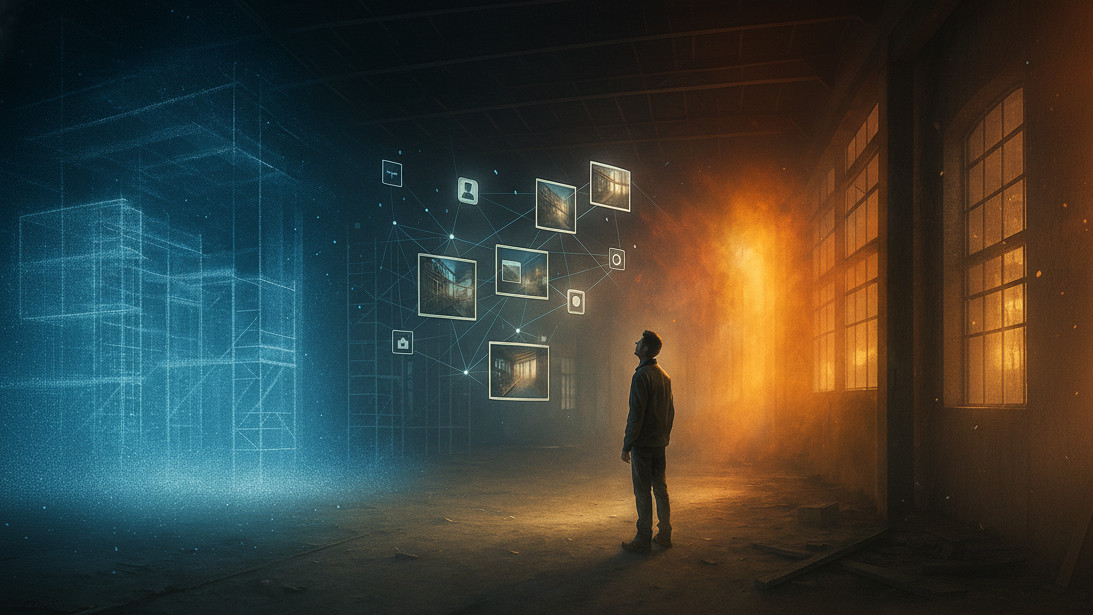
Fast, Neutral, or Photoreal? Picking the Right Reality-Capture Path for BIM

The capture stack you choose will echo through your whole project. Matterport’s turnkey flow is unbeaten for speed and predictability — great when mixed crews and tight schedules demand results on the first visit — but its best neutral outputs live behind paid add-ons. Open photogrammetry (COLMAP/AliceVision) trades convenience for control: you own the pipeline, tune it for tricky scenes, and keep custody of neutral formats, at the cost of GPU time and operator skill. AI pipelines like NeRF/Gaussian Splatting are the new fast movers: phone video in, compelling view synthesis out, with exports that are improving but still need careful scale and alignment to satisfy BIM tolerances. If long-term interoperability matters, plan your route to E57/OBJ/IFC before you set foot on site. For most work, off-the-shelf tools are enough; when you hit vast interiors or glassy, repetitive geometry, a lightly customized workflow — chunking, pose-graph tweaks, learned features — can save the day.

Common Questions

Q: How do I choose between Matterport, open photogrammetry, and AI/NeRF for my next job? A: Start from constraints: deadline, team skill, and required deliverables. If speed and a shareable viewer dominate, pick Matterport; if neutral outputs and tunability matter, go open; if photoreal view synthesis with light measurement is enough, try AI/NeRF — anchoring scale carefully.

Q: What’s the practical path to keep my data portable for BIM? A: Plan your exit to neutral formats before capture. Prioritize E57 for point clouds and OBJ/PLY (or glTF) for meshes, and archive raw imagery/video plus metadata so you can reprocess later.

Q: Can AI/NeRF pipelines meet strict dimensional tolerances? A: Sometimes, but not by default. Use surveyed control, markers, or a hybrid flow (SfM for scale and poses, then train splats/NeRF) to stabilize metric accuracy.

Q: Where do turnkey systems fall short in real projects? A: They’re superb for predictable results, but neutral exports can be add-ons and unusual scenes (glassy, repetitive geometry) may still need extra passes — or downstream cleanup in point-cloud tools.

Q: What are the hidden costs of open photogrammetry? A: Operator time and GPU/VRAM budgets. You gain control and custody, but must invest in calibration, parameter sweeps, and pipeline maintenance.

Q: How do I quality-check a capture before it hits BIM? A: Inspect reprojection errors and registration RMSE, verify unit conventions, and spot-check against control points in critical zones. Catching drift or misalignment early avoids costly rework later.

Q: When is a custom algorithmic tweak actually worth it? A: On edge cases — vast interiors, reflective/repetitive surfaces — where defaults repeatedly fail. Lightweight customizations like chunked reconstruction, pose-graph regularization, or learned features can rescue stability; otherwise, off-the-shelf is usually enough.
Contact Elf.3D to explore how custom mesh processing algorithms might address your unique challenges. We approach every conversation with curiosity about your specific needs rather than generic solutions.

*Interested in discussing your mesh processing challenges? We'd be happy to explore possibilities together.*

Reality Capture, Three Ways: Matterport, Open Photogrammetry, and AI/NeRF for BIM

Choosing a capture stack isn’t just a camera decision; it shapes everything downstream — how quickly teams can share scans, how easily geometry lands in authoring tools, and whether the organization keeps long-term custody of data. Today, three families dominate practice: turnkey platforms (e.g., Matterport), open photogrammetry (COLMAP/AliceVision), and AI-first pipelines (NeRF/Gaussian Splatting, often via Nerfstudio). Each has a clear sweet spot, and understanding the trade space helps avoid expensive rework later.

Turnkey path: Matterport

Matterport is designed for speed and predictability. The Pro3 camera couples with a guided mobile workflow and cloud processing to produce polished “digital twins” suitable for immediate sharing with non-technical stakeholders. The current product page positions Pro3 starting at $5,995, signaling a CAPEX-plus-subscription model rather than purely pay-as-you-go.

Interoperability is better than it used to be, but still gated by add-ons. The E57 export option yields a vendor-neutral point cloud aligned with ASTM E2807, while MatterPak provides OBJ/PNG/XYZ assets; Matterport also offers a Revit plug-in to bring E57/XYZ directly into projects. These pathways are robust, yet they sit behind plan tiers and add-on purchases — so neutral deliverables remain an intentional choice, not the default.

Where Matterport shines is field efficiency and predictable outcomes across varied crews. The trade-off is recurring OPEX, plus a viewer-centric ecosystem that encourages staying within the platform unless you consistently export neutral formats.

Open photogrammetry: COLMAP/AliceVision (Meshroom)

Open stacks expose every stage of the pipeline — feature extraction, matching, bundle adjustment, dense stereo, meshing — so teams can tune behavior for difficult scenes. COLMAP continues to evolve with performance and robustness improvements (e.g., multi-GPU feature extraction and matching, determinism options, and CUDA-enabled pycolmap on Linux), making it viable for scripted or semi-automated production.

On the user-interface side, Meshroom (AliceVision) offers a node-graph workflow and, in its 2025 line, emphasizes a more general “visual programming toolbox” with a plugin architecture. That matters for BIM teams because it lowers the barrier to standardizing capture recipes without hiding the knobs needed for edge cases.

The upsides are control and neutral outputs (OBJ/PLY natively and E57 via converters), along with local custody. The downsides are GPU/VRAM demands and the need for careful acquisition plans (coverage, angle diversity, exposure control). Teams must budget time for calibration, parameter sweeps, and occasional reprocessing — но once tuned, these pipelines scale well in steady-state operations.

AI/NeRF & Gaussian Splatting: fast capture, evolving exports

Neural pipelines enable compelling view synthesis from casual phone video and short image sequences, often with faster capture than structured photo sets. Nerfstudio centralizes training and — increasingly — export: ns-export can emit point clouds, TSDF volumes, Poisson or marching-cubes meshes, cameras, and gaussian-splat PLYs, feeding lightweight web viewers or engines.

For splats specifically, the documentation calls out PLY export and lists multiple third-party viewers — useful for design reviews and remote walkthroughs without heavy meshing. But there are caveats: export capabilities are feature-gated (e.g., splats exported from trained splat models, not from all NeRF methods), and metric scale usually requires markers, surveyed control, or post-hoc alignment.

The broader GSplat ecosystem is also maturing (CUDA-accelerated rasterization, memory/perf improvements), which helps with throughput but does not, by itself, guarantee BIM-grade geometry. Expect to fuse with SfM/photogrammetry or add control points when hard tolerances matter.

Interoperability & standards (what actually lands in BIM)

Interoperability hinges on a few formats:

  • E57 (ASTM E2807) for registered point clouds; it’s vendor-neutral and widely supported by authoring tools. Matterport supports E57 as an add-on, and the format’s scope — 3D points, color/intensity, and associated imagery — is well-documented.
  • OBJ/PLY for meshes used as underlays or references in DCC/BIM contexts; straightforward, but unit conventions and coordinate frames must be checked.
  • IFC 4.3.2 for neutral BIM exchange once point clouds/meshes have informed modeled elements; the current documentation set clarifies scope and terminology, aligning with the ISO release.

If long-term custody or cross-tool collaboration is a priority, plan the path from capture to one of these neutral endpoints before field work begins, so image/scan metadata, scale references, and alignment strategies are part of the acquisition plan.

Quality, fidelity, and error modes

Every stack has characteristic failure modes:

  • Photogrammetry struggles with feature-poor or highly reflective surfaces (glossy tiles, curtain wall), aggressive exposure bracketing, and repetitive patterns. Mitigations include controlled lighting, cross-polarization, and introducing textured props or coded targets for scale/loop closure.
  • NeRF/GSplat often require external cues for metric scale and benefit from mixed pipelines (e.g., initialize with SfM, train a splat, then export/align). The documentation and community guides emphasize careful handling of camera poses and coordinate frames during export.
  • Turnkey systems target robustness but can under-deliver on unusual scenes; the fix is typically to supplement with additional scan positions or to budget for exporting E57 and doing localized clean-up in point-cloud tools.

Regardless of path, enforce basic QA: check reprojection error distributions, validate registration against control points, and compute alignment RMSE before scans flow into authoring.

Costs over time (CAPEX vs OPEX vs Staff Time)

Turnkey platforms convert uncertainty into subscriptions and per-space add-ons. Hardware is an upfront cost (e.g., Pro3), but the predictability of guided capture and cloud processing reduces on-site risk and training time — valuable when deadlines or mixed-skill crews are the constraint.

Open photogrammetry shifts cost toward staff time and GPUs. The software is free, cameras can be commodity, and once a recipe is standardized, incremental jobs are inexpensive — ideal for teams running frequent scans with consistent conditions.

AI/NeRF stacks can minimize capture overhead (walk-through video; few minutes on site) but still incur compute during training and, if meshes are required, extra steps for extraction and cleanup. Export surfaces are improving, yet they remain the gating factor for strict BIM tolerances.

Governance: data control, retention, and exit ramps

Highly regulated or sensitive sites may require local processing and strict custody. Even in cloud-friendly contexts, define an exit ramp: always archive raw images/video, project metadata, and neutral exports (E57, OBJ/PLY). Matterport’s support pages explicitly position E57 as a vendor-neutral escape hatch; treat it — and its associated imagery — as part of the official record.

A compact decision frame

  • Speed & reliability vs control & tunability. Choose turnkey when capture must succeed on the first visit with minimal tuning; choose open/AI when scene conditions are atypical or parameters materially affect outcomes.
  • Interoperability vs convenience. If downstream modeling is primary, prioritize pipelines with first-class E57/IFC pathways; if rapid visualization and sharing dominate, viewer-centric ecosystems are fine — provided you budget for neutral exports later.
  • Fidelity vs robustness. Open/AI pipelines can reach remarkable detail, but they’re less forgiving in edge cases; turnkey aims for consistent “good enough.”
  • When custom work is justified. In very large interiors or in glassy/repetitive spaces, bespoke chunking, pose-graph regularization, and learned features can stabilize alignment and reduce reprocessing — useful where off-the-shelf settings repeatedly fail. Otherwise, standard toolchains are usually sufficient.

Table — Pipeline at a Glance

Aspect Matterport Open Photogrammetry AI/NeRF/GSplat
Capture Pro3 + guided app DSLR/phone; planned photo sets Phone video / short image sets
Processing Cloud automated Local GPU/cluster Local or cloud
Exports E57 add-on; MatterPak OBJ/PLY; E57 via tools PLY splats; meshes via ns-export
Strength Speed, polish, support Control, neutrality, custody Fast capture; strong visualization

Sources: Matterport Pro3 & E57 pages; COLMAP releases; Nerfstudio export docs.


Bottom line

If the priority is fast capture with predictable outcomes and a shareable viewer, a turnkey platform is hard to beat. If neutral deliverables, tunability, and local custody matter most, open photogrammetry is a strong default — especially once a team codifies its recipe. And where quick, photoreal view synthesis is the goal, AI/NeRF pipelines are now practical additions to the BIM toolbox, provided you anchor scale and mind the export surface.


References (selected)

  1. Matterport Pro3 product page (pricing/spec). matterport.com/pro3
  2. Matterport E57 overview & Revit plug-in note. support.matterport.com/s/article/Overview-of-Matterport-E57-File
  3. COLMAP release notes (multi-GPU, determinism, CUDA pycolmap). github.com/colmap/colmap/releases
  4. Meshroom 2025.1 announcement (plugin architecture). groups.google.com/g/alicevision/c/a9xGujkF-6c
  5. Nerfstudio export (ns-export) and splat export notes. docs.nerf.studio/reference/cli/ns_export.html
  6. buildingSMART IFC 4.3.2 documentation (current line). ifc43-docs.standards.buildingsmart.org
  7. Library of Congress format description for E57/ASTM E2807 (scope/details). loc.gov/preservation/digital/formats/fdd/fdd000563.shtml