
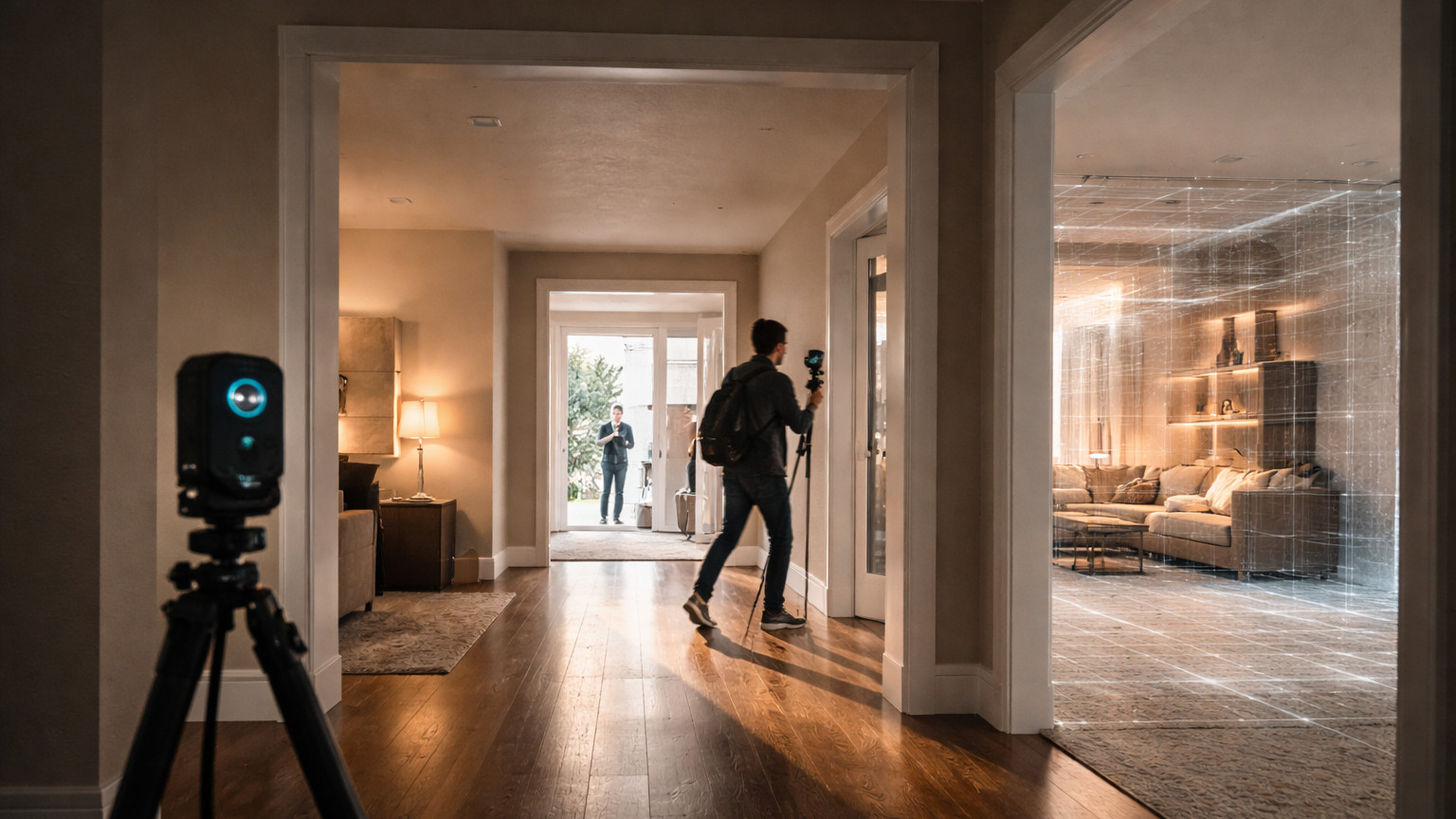
Residential virtual tours get judged on “wow” — but they survive on workflow. A platform that reliably produces a navigable experience in hours (not days) changes how listings go live, how teams staff capture, and whether anyone trusts the measurements later. That’s why the real comparison isn’t “Which tour looks better?” It’s how each pipeline turns on-site capture into three different kinds of value:
Matterport’s signature advantage is the Dollhouse — a global 3D overview that helps viewers instantly grasp layout. Matterport explicitly frames Dollhouse as a viewing mode alongside 3D, 360, and Video. But many alternatives (Metareal Stage, Asteroom, and others) can deliver compelling tours too — often with more camera freedom, and sometimes with different expectations around accuracy and portability.
What follows is a decision-oriented breakdown of where automation wins, where it hides the work, and how to choose without mixing up “marketing measurements” with “measurement standards.”
| Archetype | Primary capture | Model build | Typical deliverables |
|---|---|---|---|
| Automation-first “digital twin” | LiDAR camera / 360 / phone | Automated reconstruction | Dollhouse + walkthrough + derived assets |
| 360-first DIY authoring | 360 / DSLR panoramas | Manual assembly & editing | 3D pano tour + labels + floor plan exports |
| Phone/kit + cloud processing | Smartphone + kit | Cloud processing | Dollhouse-like view + 2D plans (tolerance varies) |
Matterport’s positioning is explicit: Cortex AI is fully automated and combines computer vision, image processing, and deep learning to create 3D spatial data from a variety of capture devices. Metareal’s Stage documentation describes its output as “3D panorama tours” — a tour type where users move proportionally between panorama images in a 3D space, hosted and shared as a web link. Asteroom’s documentation and support materials lean into a lightweight model: verify the 3D dollhouse result, then order a 2D floor plan converted from it (with tripod height used to determine dimensions).
Already you can see the pattern: automation compresses decisions into the platform, while 360-first workflows push more decisions to the author (or to an artist-assisted service). That trade changes everything downstream.
Matterport’s Pro3 technical specs (as updated in late 2025) list accuracy as ±20 mm @ 10 m. Matterport’s store listing clarifies the context: that error rate applies to raw depth output, and it recommends measuring between nearer points for better reliability — an important nuance when someone assumes every on-screen measurement is uniformly trustworthy.
Even with a solid sensor, end-to-end fidelity depends on capture behavior: scan spacing, coverage, and challenging surfaces (mirrors, glass, glossy cabinetry). Hardware specs help set expectations, but they don’t eliminate systematic issues like alignment drift in long, low-feature corridors or ambiguity around openings.
Metareal’s pitch is essentially that you can use “just about any” panorama-capable camera and build tours without specialized scanning hardware. That freedom can be a major advantage in difficult lighting (or when a team already owns good cameras). But it also shifts responsibility: consistent pano placement, tripod height discipline, and coverage choices become the “calibration” your final outputs inherit.
Asteroom makes the dependency explicit. Its support article states it can guarantee ±10% for dimensions on standard 2D floor plans and that it uses tripod height to determine room dimensions in both the 3D dollhouse and 2D floor plans. That’s not “bad” — it’s simply a different contract with the user: acceptable for many marketing contexts, risky for standards-driven ones.
Matterport’s advantage is consistency of deliverable shape: you capture, upload, and the platform produces an experience with standardized viewing modes (including Dollhouse). It also offers guided tour tooling and best-practice guidance (updated late 2025) for creating a structured walkthrough experience.
Metareal’s Stage ecosystem is more explicit about “build” as a step. Tour exporting is described as experimental in its Stage documentation, with 2D exports (SVG/DXF) for floorplans available under paid tiers and limited 3D export testing (e.g., FBX) referenced as not generally available. That’s a classic control-versus-productization trade: more flexibility for certain workflows, but potentially more variability in pipeline maturity across features.
A balanced way to frame it: Matterport optimizes for predictable outcomes; 360-first platforms often optimize for optionality. Which matters more depends on how many properties you process, who authors tours, and whether you need a repeatable QC story.
Dollhouse is persuasive because it lowers cognitive load. When viewers can rotate an entire home as a coherent object, they stop asking “Where am I?” and start asking “Do I like this?” Matterport’s own viewing mode documentation highlights Dollhouse as part of the standard viewing set after upload.
That doesn’t mean 360-first tours are inherently less immersive. Metareal’s Stage documentation emphasizes proportional movement between panoramas in 3D space, which can feel closer to “walking” than classic click-through pano galleries. But achieving equal legibility often requires more authoring intent: defining pathways, smoothing transitions, and (crucially) annotating.
If a tour is purely marketing, annotations are optional. The moment it supports handoff, inspection, or decision-making, annotations become the product.
Matterport’s help center frames tags as a way to call out features and add context. Metareal’s Labels are explicitly positioned as annotations that can contain text, images, videos, links, tables, and more — useful when a tour doubles as a lightweight knowledge base.
This is one area where “feature parity” can mislead. Two platforms can both “support labels,” but the workflow differs: how fast can an author place them, how discoverable are they to viewers, and how easily can they connect locations or sections? (Metareal even documents “linking locations with labels,” which hints at how its authoring model expects composition.)
When someone asks “Is it accurate?” they’re usually mixing:
Matterport’s measurement accuracy article (updated Aug 2025) claims that, in general, room dimensions measured on models from certain Matterport cameras were typically within ~1% of ground-truth measurement (with caveats and context). Asteroom’s standard 2D floor plan guidance uses a ±10% guarantee. An independent academic study evaluating a Matterport indoor camera notes that despite automation, final accuracy can be “questionable” and that detailed research is limited — effectively a reminder that results are conditional and should be validated for the intended use.
Those statements aren’t mutually exclusive; they reflect different definitions, workflows, and measurement targets. The practical takeaway is to separate deliverables:
Reported area ≠ “whatever the mesh encloses.” In standards-driven contexts, reported area is a rules-based artifact:
Reported area ≈ Σ(areas included by standard) − Σ(exclusions required by the same standard)
Fannie Mae’s SEL-2025-04 announcement (June 4, 2025) states that it updated Selling Guide language to align with ANSI Z765-2021 measurement terminology, replacing legacy terms with above-grade / below-grade finished area language, and it provides an implementation timeline tied to UAD 3.6 and UCDP submission requirements (encouraged beginning Jan 26, 2026; required for certain submissions on/after Nov 2, 2026). A related Fannie Mae document on standardizing property measuring guidelines reinforces ANSI Z765-2021 as a shared measurement standard that technologies can build to and appraisers can consume with confidence.
So, if you’re operating near appraisal or lending workflows: treat virtual tour measurements and ANSI-aligned reporting as separate tracks unless the platform and process explicitly support the latter.
| Use case | Accuracy expectation | Standards pressure | Practical implication |
|---|---|---|---|
| Listing marketing | Approximate OK | Low | Optimize for speed + UX |
| Renovation scoping | Moderate | Medium | Spot-check key dims; document assumptions |
| Appraisal/lending reporting | High | High (ANSI) | Separate standards workflow; retain method evidence |
In narrow, high-throughput portfolios or edge-case geometry (mirrors, long corridors, mixed interior/exterior), a tailored QC layer — for example, automated drift flags between floors or scale consistency checks — can reduce rework compared to relying on general-purpose defaults alone.
If the tour must outlive the platform — or feed AEC tooling — exports matter more than “share a link.”
Matterport documents E57 exports as a vendor-neutral, high-density point cloud defined by ASTM E2807, intended to support complex workflows across many 3D applications. Matterport also provides a catalog of downloadable assets for backup and reuse (updated Nov 2025) and describes the MatterPak bundle as a set of assets that can be imported into third-party programs.
Metareal’s floorplan export article states you can export generated floorplans as DXF or SVG (tier-dependent), which is often enough for lightweight drafting or presentation workflows. Its documentation also signals that broader tour/model export is evolving (with experimental/beta notes).
The healthy mental model is: floorplan exports help drawing workflows; point cloud exports help reconstruction workflows; neither automatically creates BIM. They’re bridges — not guarantees.
Occupied homes contain faces, documents, and personal artifacts. Matterport supports automatic face blurring (support documentation updated Aug 2024) and a manual blur brush article updated Dec 2025; it also clarifies in a Feb 2026 article that the manual blur brush is human-controlled rather than AI-driven.
Governance is a workflow, not a setting:
| Priority | Favors automation-first (Matterport-style) | Favors 360-first DIY (Metareal-style) | Favors phone/kit cloud (Asteroom-style) |
|---|---|---|---|
| Fast, repeatable output | Strong | Medium | Strong |
| Max camera flexibility | Medium | Strong | Medium |
| Annotation-heavy “spatial doc” | Strong | Strong | Medium |
| Standards-adjacent reporting | Needs separate workflow | Needs separate workflow | Needs explicit appraisal-grade offering/process |
| Portability into AEC tools | Strong via E57/MatterPak | Medium (DXF/SVG; evolving 3D export) | Low–Medium (depends on outputs) |
The simplest rule: choose your tour platform based on immersion + operational speed, and choose your measurement workflow based on standards pressure. Those can be the same tool in some contexts — but they don’t have to be.